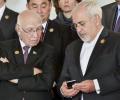
He did not mention the issue of Jammu and Kashmir.

Intelligence Bureau officers say the problem lies with the government treating narcotics and terrorism as two separate problems, with different law-enforcing agencies for each, and this ends up in defeating the purpose. Vicky Nanjappa reports.

It further said India is facilitating external commercial borrowings by startups in order to encourage innovation and promote ease of doing business.

Modi is the first foreign leader to be invited to the palace by the Crown Prince, who appreciated the role played by Indian workers in the development of UAE as a modern nation, ministry of external affairs spokesperson Raveesh Kumar tweeted.
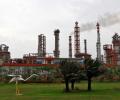
The agreement came in after the Ruias agreed to clear most of the Rs 26,000-crore dues to the lenders on completion of the transaction.
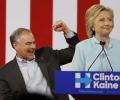
Rediff.com reproduces this 2014 interview with Tim Kaine where in he discusses the new opportunities to foster Indo-US trade and the improvement in ties.

Another point of contention is the invoice issued by the e-companies.
CBI sources said the shell companies were allegedly being used by the suspects to divert loan funds meant for specified purposes, creating fake invoices, and 'round-tripping' of funds to evade taxes and generate black money.

Indians at large harbour a notion that their country is cherrypicking out of the American basket of goodies, but the policymakers in Delhi and the political leadership are well aware that it can only be a pipe dream since a military alliance with a superpower is a profound irrevocable commitment, observes Ambassador M K Bhadrakumar.

'Tax dodging through tax havens is one of the ways multinational corporations and the super-rich in India are using to evade taxes.'
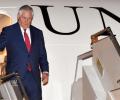
Pakistan Prime Minister Shahid Khaqan Abbasi assured the Secretary of State that his country is committed to the war against terrorism.

Ashish Chauhan is generous in his praise for his former bosses and doesn't flinch in pointing out the reasons why the BSE lost out in the initial years of the NSE.

Prime Minister Narendra Modi said India and the United Kingdom are economically made for each other.

'Look East' policy was first coined by the Narasimha Rao government in the 1990s and has been followed by the successive governments.
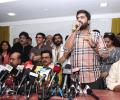
The elections were recently postponed.

Khan said Kashmir is the 'core' issue between the two countries and it should be resolved through talks.

With Beijing having had a profound rethink on India's admission as a full member of the Shanghai Cooperation Organisation, the tectonic plates of the geopolitics of a massive swathe of the planet stretching from the Asia-Pacific to West Asia are dramatically shifting. That grating noise in the Central Asian steppes will be heard far and wide -- as far as North America, says Ambassador M K Bhadrakumar.

The IMG meeting will be convened shortly.

New Delhi remains a priggish suitor to Washington's overtures, but it has begun appreciating potential tech benefits to ties with the US.

The fact that the US dollar has become the world's preferred reserve currency is now the core of global financial crisis, says Mohan Guruswamy.
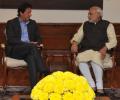
'Modi loves to keep others guessing and basks in the media glare, both traits that are politically helpful but are inimical to stable relations, especially in the fragile Indo-Pak equation.'

The joint statement issued after Prime Minister Narendra Modi and President Barack Obama's first-ever summit is high on intent and ambition. Notably missing from the statement is India's refusal to be America's partner in its war against ISIS.

'China's deep involvement in the stability and economic and political success of Pakistan actually produces some elements of congruence with India's core interest in a stable and productive relationship with Pakistan.' 'It is not far-fetched for us to pursue that congruence and with ingenuity work out with China a formula that also satisfies our formal position on PoK,' argues Ambassador Kishan S Rana.

The company is modelling its many ventures on Alibaba in China.
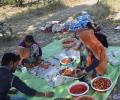
'To bring about a paradigm shift in farmers's income, we need to change our approach to agriculture, and transit from the narrow prism of cultivation to a full-fledged enterprise, by building all associated supply chain linkages.' 'This alone will make the farmer an entrepreneur in his own right.'

'While military acts such as the Uri surgical strikes are one option, cultural, economic and diplomatic isolation should also be part of the arsenal,' argues Sankrant Sanu.

Amid a spurt in terror attacks in various countries, Prime Minister Narendra Modi on Thursday said terrorism is the "gravest threat" to the world, "equally impacting" India and Mozambique which agreed to strengthen security and defence ties and bolster cooperation in food security.

Dr Behera speaks about how the nationwide positive reaction to the abrogation of Article 370 in Jammu and Kashmir indicates that the very idea of India is changing. From a diverse, multicultural entity, could India be becoming a place where assimilation is more important than accommodation?

'Ensuring through diplomatic means and in conjunction with strategic partners that India will not be required to fight a simultaneous two-front war with China and Pakistan.' Brigadier Gurmeet Kanwal (retd) lists what India must have in its national security strategy.

"Not a single step has been taken by this government to empower small businesses in India," says Praveen Khandelwal, national secretary general of the Confederation of All India Traders and former treasurer of the Bharatiya Janata Party's Delhi unit.

India and China on Friday agreed to set up a dedicated communication channel to boost security cooperation as Home Minister Rajnath Singh held talks with China's security czar on issues like cross border terrorism from Pakistan and the Afghan situation.

Recognising the threat posed by outfits like the Al Qaeda, Lashkar-e-Tayiba and the Dawood Ibrahim network, India and the United States have agreed to deepen cooperation in fighting terrorism and asked Pakistan to bring to justice the 2008 Mumbai attack perpetrators.

'By the time he came out after nearly five hours, he had a one-to-one conversation with the President, a delegation-level meeting, a reception, a dinner, a tour of the White House and a joint statement of a kind none of his predecessors ever had,' says Ambassador T P Sreenivasan.

'Most of the agitations are staged by the Opposition to disturb the peace of the state.'

China on Monday opened the second land crossing in Tibet via Nathu La to allow the first batch of Indian pilgrims undertaking the arduous Kailash-Manasarovar Yatra, in the latest confidence-building measure between the two neighbours.

'The majority of transmission will be via people who are within two metres of one another.' 'The closer you are, the more likely that you'll be infected.'
'After more than 20 years of understanding, nothing much seems to have been achieved. What the two countries have been trying to do is to manage the recurrence of border incursions. The two sides must address the disease, and not the symptom of the disease,' says Rup Narayan Das.

While some CMs suggested reopening economic activity in phases, others pitched for the extension of the coronavirus lockdown, but with a carefully crafted exit strategy

Unlike most Bollywood kids whose careers tend to play out in fits and starts, Alia's growth has been swift and steady.

Sri Lanka's signals -- that it is ready for 'joint fishing' initiatives -- and Tamil Nadu fishermen's sticking to commitments have paved the way for a negotiated settlement on a long festering issue, says N Sathiya Moorthy
